How to Stop Beagle Puppy Chewing
If you’re dealing with Beagle puppy chewing, you’re not alone. Puppies naturally explore their surroundings with their mouths, and teething can make chewing especially appealing. Beagles can also become interested in household objects because they are curious, energetic scent hounds that enjoy exploring their environment.
The goal isn’t to prevent your puppy from chewing altogether. Instead, you want to teach your Beagle what is appropriate to chew and what should be left alone.
With supervision, appropriate chew toys, puppy-proofing, mental stimulation, and consistent positive training, you can help your Beagle develop good chewing habits.
Beagle Puppy Chewing
Quick Answer
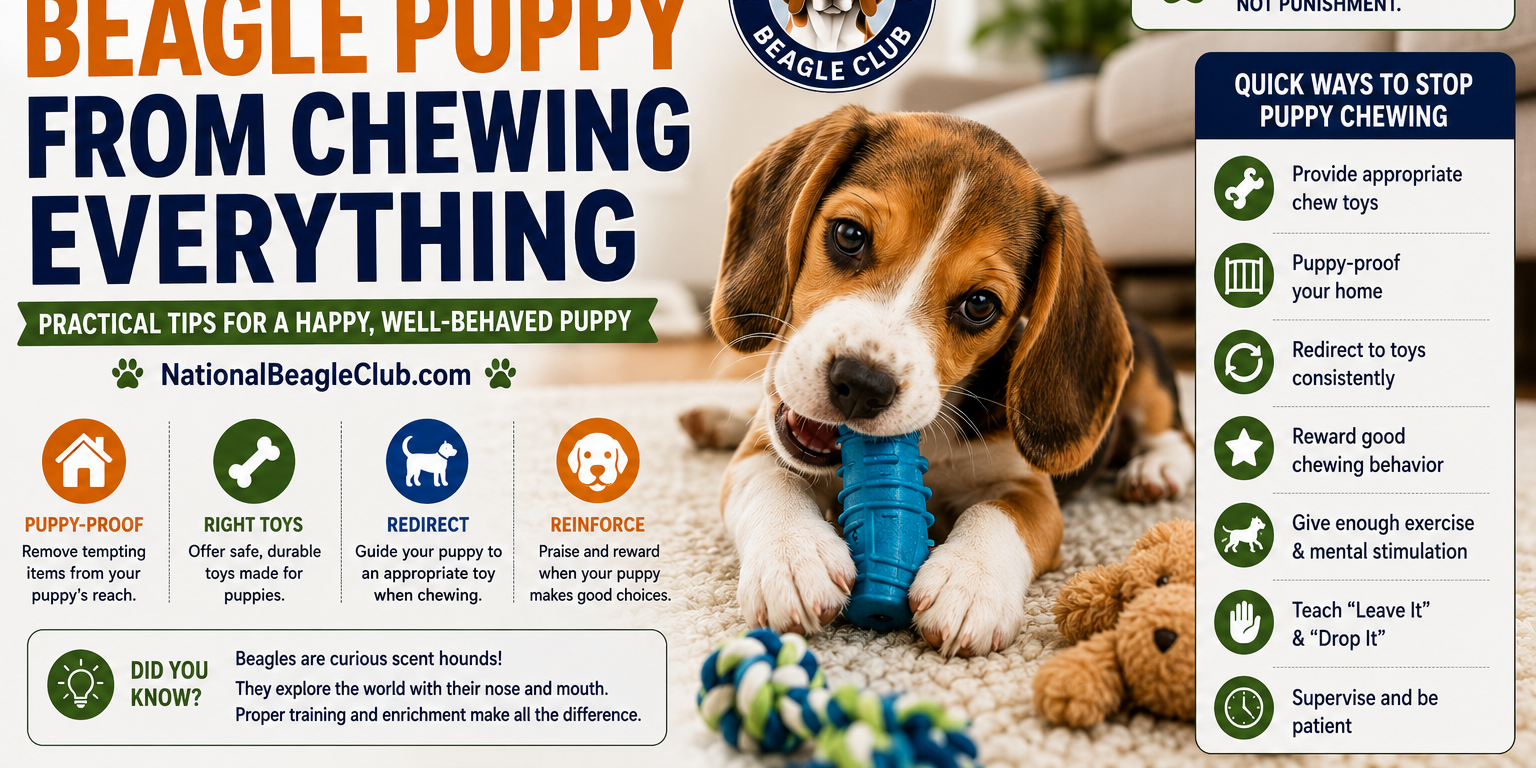
To stop Beagle puppy chewing, provide appropriate puppy-safe chew toys, keep tempting household objects out of reach, supervise your puppy, redirect inappropriate chewing toward an approved toy, and reward the behavior you want. Teaching cues such as “Leave It” and “Drop It” can also help. Chewing is a normal part of puppy development and may increase during teething.
Avoid harsh punishment. Consistent management and positive reinforcement help puppies learn appropriate chewing habits.
Why Does Beagle Puppy Chewing Happen?
Before trying to stop Beagle puppy chewing, understand why your puppy is doing it.
Common reasons include:
- Teething
- Exploring the environment
- Boredom
- Excess energy
- Seeking attention
- Normal puppy development
- Enjoying a particular texture
- Smelling an interesting scent
- Lack of appropriate chewing outlets
Puppies naturally investigate objects with their mouths. Chewing can also provide relief while they are teething.
Beagle Puppy Chewing During Teething
Teething can make puppies especially interested in chewing.
As your Beagle’s puppy teeth are replaced by adult teeth, chewing can become a natural way to explore and relieve mouth discomfort.
Provide appropriate options such as:
- Puppy-safe rubber toys
- Appropriate teething toys
- Food-stuffed toys
- Durable puppy toys
- Other veterinarian-approved chewing options
Always choose toys appropriate for your puppy’s size, age, and chewing style.
When Does Beagle Puppy Chewing Usually Improve?
Many puppies become less interested in chewing as they mature and finish teething, but the exact timeline varies.
The American Kennel Club notes that puppies generally have their adult teeth by around 6 months, although chewing can continue later when dogs are bored or insufficiently stimulated.
That means you shouldn’t simply wait for the chewing phase to disappear.
Use puppyhood to teach appropriate habits that can continue into adulthood.
What Do Beagle Puppies Like to Chew?
A Beagle puppy may investigate almost anything within reach.
Common targets include:
- Shoes
- Socks
- Furniture
- Blankets
- Books
- Remote controls
- Cardboard
- Plants
- Clothing
- Children’s toys
Objects carrying your scent can be especially interesting to dogs.
The easiest way to prevent unwanted chewing is to make inappropriate objects inaccessible.
How to Stop Beagle Puppy Chewing
1. Puppy-Proof Your Home
The first step in managing Beagle puppy chewing is removing opportunities for your puppy to practice the unwanted behavior.
Put away:
- Shoes
- Clothing
- Cables
- Small objects
- Children’s toys
- Remote controls
- Books
- Trash
- Potentially harmful household items
Remember that anything within your puppy’s reach may become a potential chew toy.
Puppy-proofing is often more effective than repeatedly correcting a puppy after they have already grabbed something.
2. Give Your Beagle Appropriate Chew Toys
Your puppy needs something acceptable to chew.
Keep appropriate toys available throughout the day.
Consider having several different textures and types of toys rather than relying on one toy.
For example:
- Rubber toys
- Puppy teething toys
- Food-stuffed toys
- Interactive toys
- Appropriate chew products
Inspect toys regularly and remove damaged items.
3. Redirect Beagle Puppy Chewing
If your Beagle starts chewing something inappropriate, calmly redirect them.
For example:
Puppy: Chews furniture
Owner: Calmly interrupts and offers an appropriate toy
Puppy: Chews toy
Owner: Praises and rewards the puppy
The lesson is simple:
“This is what you can chew.”
The AKC recommends redirecting puppies toward appropriate chew toys and teaching them what they are allowed to chew.
4. Reward Good Chewing Habits
Don’t only react when your Beagle does something wrong.
Notice when your puppy independently chooses an appropriate toy.
When they do:
- Praise them.
- Give gentle attention.
- Offer a reward when appropriate.
- Continue allowing them to enjoy the toy.
Positive reinforcement helps your puppy understand which behaviors you want repeated.
5. Teach Your Beagle “Leave It”
“Leave It” is an extremely useful command for preventing unwanted chewing.
Start in a quiet environment.
Practice with an uninteresting object first and reward your puppy for moving their attention away from it.
Gradually increase the difficulty as your puppy learns.
The command can eventually help your Beagle leave household objects, outdoor items, and other distractions alone.
6. Teach “Drop It”
“Drop It” is useful when your puppy has already picked something up.
Instead of chasing your puppy, calmly encourage them to exchange the object for something appropriate.
The AKC recommends teaching a “Drop It” or “Out” cue and using a trade rather than chasing the dog for an object.
This also helps prevent your puppy from learning that stealing objects creates an exciting game of chase.
Beagle Puppy Chewing and Boredom
Boredom can contribute to destructive chewing.
Beagles are scent hounds that benefit from activities involving both their bodies and their minds.
Provide age-appropriate:
- Training sessions
- Scent games
- Walks
- Play
- Puzzle toys
- Food-search activities
- Supervised exploration
Mental stimulation is particularly useful for a breed that naturally enjoys following scents and investigating its surroundings.
Beagle Puppy Chewing When Left Alone
If your puppy repeatedly destroys objects when you’re away, management becomes especially important.
Before leaving your puppy:
- Remove tempting objects.
- Provide a safe puppy area.
- Leave appropriate toys.
- Make sure the environment is secure.
- Consider a crate or puppy-proofed area when appropriate.
The AKC recommends using a crate or dog-secure area when a puppy cannot be supervised and providing appropriate toys to keep them occupied.
If destructive behavior is severe or occurs alongside signs of distress whenever you leave, discuss the situation with your veterinarian or a qualified behavior professional.
Rotate Your Beagle’s Toys
Having every toy available all the time can make toys less interesting.
Instead, rotate them.
Keep a small selection available and introduce others later.
This can help maintain novelty while giving your Beagle appropriate alternatives to household objects. The AKC similarly recommends rotating toys rather than leaving all of them available constantly.
Don’t Chase Your Beagle for Stolen Items
Chasing can accidentally turn chewing into a game.
Your puppy grabs a sock.
You chase.
Your puppy runs.
You chase faster.
To your puppy, this can become exciting play.
Instead, calmly use a trained “Drop It” cue or offer an appropriate trade when it is safe to do so.
Don’t Punish Beagle Puppy Chewing After the Fact
If you discover that your puppy destroyed something while you were away, punishment after the event won’t teach the puppy what they should have done instead.
Focus on prevention.
Ask:
How did my puppy gain access to this object?
Then change the environment so the same opportunity doesn’t happen again.
Positive training and management are more useful than harsh punishment.
How to Protect Furniture From Beagle Puppy Chewing
If your Beagle repeatedly targets furniture:
- Limit access when you cannot supervise.
- Provide appropriate chew toys.
- Redirect the puppy when chewing begins.
- Reward toy chewing.
- Increase appropriate mental stimulation.
- Make the furniture less accessible where practical.
Consistency matters.
Every successful opportunity to chew furniture can reinforce the habit, so prevention is important.
How to Stop Your Beagle Puppy From Chewing Shoes
Shoes are common puppy targets.
Keep shoes inside a closed closet, cabinet, or another inaccessible location.
Don’t leave them scattered around the house and expect a young puppy to understand that one shoe is acceptable while another is forbidden.
Give your puppy an appropriate alternative and reward them for choosing it.
How to Stop Beagle Puppy Chewing on Clothing
Clothing carries familiar human scents, making it interesting to dogs.
Keep laundry in a closed hamper rather than on the floor.
If your puppy grabs clothing:
- Stay calm.
- Avoid turning it into a chase.
- Use “Drop It” when trained.
- Offer an appropriate toy.
- Praise the puppy after the exchange.
Safe Management While You Are Busy
You cannot supervise a puppy every second.
When you need to focus on something else, use an appropriate puppy-safe environment.
Options may include:
- A properly introduced crate
- A puppy-proofed room
- A secure playpen
- A gated area
Make sure the area is safe and appropriate for your puppy.
Supervision and environmental management are important parts of preventing destructive chewing.
When Beagle Puppy Chewing May Be a Concern
Normal puppy chewing is expected.
However, contact your veterinarian if your puppy:
- Frequently swallows non-food objects.
- Chews potentially dangerous substances.
- Damages teeth while chewing.
- Shows signs of mouth pain.
- Suddenly develops unusual chewing behavior.
- Repeatedly eats objects rather than simply chewing them.
If you are concerned about your puppy’s behavior or health, professional veterinary advice is appropriate.
Beagle Puppy Chewing Training Routine
Try this simple daily routine:
Morning
- Potty break
- Age-appropriate activity
- Short training session
- Appropriate chew toy
Afternoon
- Rest
- Play
- Mental enrichment
- Supervised chewing
Evening
- Walk or appropriate exercise
- Training
- Calm play
- Chew toy while settling
The exact routine should be adapted to your puppy’s age, health, sleep needs, and individual temperament.
Frequently Asked Questions About Beagle Puppy Chewing
Why Does My Beagle Puppy Chew Everything?
Puppies naturally explore their environment with their mouths. Teething, curiosity, boredom, attention seeking, and excess energy can all contribute to chewing. Beagles may also be particularly interested in investigating scents around the home.
What Can I Give My Beagle Puppy to Chew?
Give your puppy toys and chew products specifically designed for puppies and appropriate for their size and chewing behavior. Ask your veterinarian if you’re uncertain whether a particular product is appropriate.
At What Age Do Beagle Puppies Stop Chewing Everything?
Chewing often decreases as puppies mature and finish teething, with many puppies having their adult teeth by around 6 months. However, dogs can continue chewing throughout life, particularly when bored or under-stimulated.
Should I Punish My Beagle Puppy for Chewing Furniture?
No. Punishment after the behavior has occurred does not teach your puppy what to do instead. Prevent access, redirect toward an appropriate toy, and reward good chewing choices.
How Do I Stop My Beagle Puppy From Chewing Shoes?
Keep shoes out of reach, provide appropriate chew toys, and calmly redirect your puppy whenever they approach an inappropriate object. Consistency helps your puppy learn which objects are available for chewing.
Should I Teach My Beagle “Leave It” and “Drop It”?
Yes. Both commands are useful life skills. “Leave It” teaches your puppy to disengage from an object, while “Drop It” teaches them to release something already in their mouth.
Why Does My Beagle Puppy Chew When Left Alone?
Your puppy may be bored, under-stimulated, or experiencing distress when separated from you. Make sure your puppy has a safe environment and appropriate enrichment. If you suspect separation-related anxiety, speak with your veterinarian or a qualified behavior professional.
Is It Normal for a Beagle Puppy to Chew During Teething?
Yes. Chewing is a normal puppy behavior, and teething can increase the desire to chew. Providing appropriate puppy-safe chewing options can help direct this behavior toward acceptable objects.
Final Thoughts
Beagle puppy chewing is a normal part of development, but that doesn’t mean your puppy should be allowed to chew everything in the house.
The most effective approach combines management, supervision, appropriate chew toys, positive reinforcement, and consistent training.
Puppy-proof your home, give your Beagle plenty of appropriate chewing opportunities, teach useful cues such as “Leave It” and “Drop It,” and reward your puppy whenever they make a good choice.
Remember that your Beagle is still learning. Patience and consistency today can help establish better habits that continue into adulthood.