
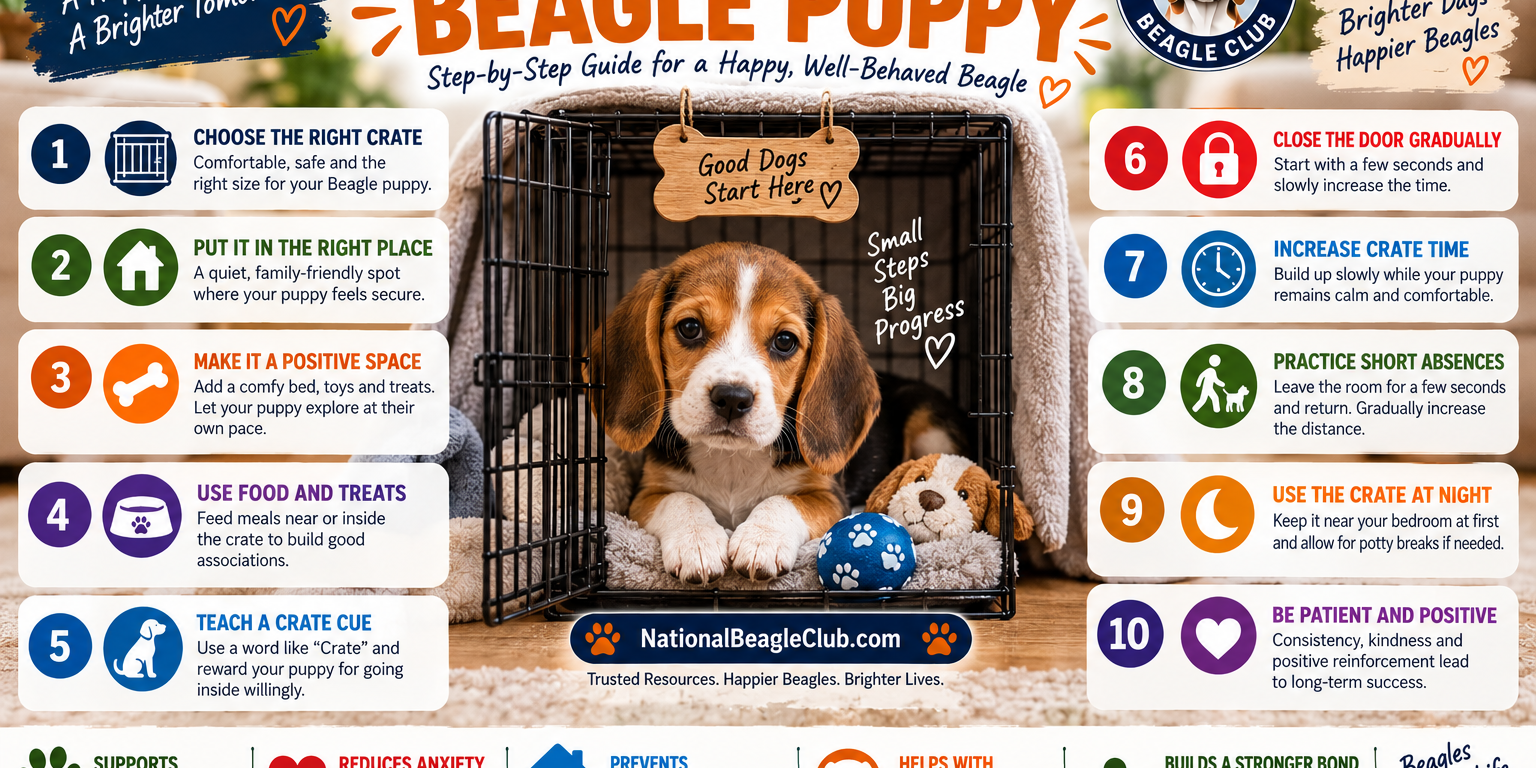
Learning how to crate train a Beagle puppy can make the first few months at home easier, safer, and more predictable. When introduced correctly, a crate can become a comfortable place for your Beagle to sleep, relax, travel, and take quiet breaks.
Beagles are curious, energetic scent hounds, so puppies can quickly find things to chew, explore, or investigate. A properly introduced crate gives your puppy a safe space while also supporting potty training, daily routines, and supervised alone-time practice. AKC guidance recommends making the crate a positive place rather than using it as punishment.
The key is patience, positive reinforcement, and gradual progress. Your goal is not simply to get your Beagle inside the crate. Your goal is to teach your puppy that the crate is a safe and rewarding place to relax.
How to Crate Train a Beagle Puppy
The easiest way to approach how to crate train a Beagle puppy is to divide the process into small steps.
Start with:
- Choosing the correct crate.
- Making the crate comfortable.
- Allowing your puppy to investigate it.
- Rewarding voluntary entry.
- Feeding meals near or inside the crate.
- Gradually introducing the closed door.
- Increasing crate time slowly.
- Practicing while you remain nearby.
- Gradually increasing distance.
- Building short periods of alone time.
Do not rush through the stages.
If your Beagle becomes worried, go back to the previous step and make the exercise easier.
Choosing the Right Crate for a Beagle Puppy
The crate should be large enough for your puppy to:
- Stand comfortably
- Turn around
- Lie down
- Stretch naturally
- Change sleeping positions
However, avoid choosing a crate that is excessively large for a young puppy.
If you purchase a crate that will accommodate your Beagle’s adult size, an adjustable divider can help create an appropriately sized puppy area. AKC recommends a crate that allows the puppy to stand, turn around, and lie down comfortably, with dividers useful as the puppy grows.
What Type of Crate Should You Use?
Common options include:
- Wire crates
- Plastic travel crates
- Soft-sided crates
- Furniture-style crates
For a puppy, choose a crate that is secure, well ventilated, appropriately sized, and easy to clean.
A wire crate can also be partially covered if your puppy settles better with a more sheltered environment, but always maintain adequate airflow.
Where Should You Put a Beagle Puppy Crate?
Location matters.
Place the crate somewhere your puppy can feel connected to the household without being surrounded by constant activity.
Good locations may include:
- A quiet corner of the living room
- A bedroom at night
- A family room
- Near your home office
Avoid placing the crate somewhere isolated where your puppy is completely separated from everyone.
For nighttime, keeping a young puppy’s crate near your bedroom can make it easier to hear when they need a bathroom break and can help them feel less alone.
AKC recommends a relatively quiet area where the puppy can relax rather than an environment filled with constant commotion.
Make the Beagle Puppy Crate a Positive Place
Before closing the door, teach your puppy that good things happen around the crate.
Leave the door open.
Place a few treats near the entrance.
Praise your puppy for investigating.
You can gradually place treats farther inside.
Do not push your Beagle into the crate.
Let your puppy make the choice to enter.
This creates a positive association with the crate instead of making it something your puppy tries to avoid.
AKC recommends rewarding voluntary exploration and gradually encouraging the puppy farther into the crate before introducing door closure.
Step 1: Let Your Beagle Puppy Explore the Crate
Put the crate in its chosen location and secure the door so it cannot accidentally swing shut.
Allow your puppy to investigate.
Your Beagle may:
- Sniff the crate
- Walk around it
- Look inside
- Put one paw inside
- Walk away
- Return later
All of this is normal.
Reward curiosity.
You can toss a small treat near the entrance.
When your puppy becomes comfortable, toss another treat just inside.
Eventually, place rewards farther inside.
Do not worry if your puppy does not immediately climb all the way in.
Step 2: Feed Your Beagle Puppy Near the Crate
Food is an excellent way to create positive associations.
Begin by feeding your puppy near the crate.
If your puppy is comfortable, gradually move the food bowl closer to the entrance and then farther inside.
Eventually, your puppy can eat meals inside the crate while the door remains open.
AKC specifically recommends using meals, treats, toys, and praise to help dogs develop positive associations with the crate.
Never force your puppy into the crate to eat.
If your Beagle refuses to eat inside, move the bowl back toward the location where your puppy feels comfortable and try again later.
Step 3: Teach Your Beagle Puppy to Enter on Cue
Once your puppy happily enters the crate, introduce a simple verbal cue.
You might use:
“Crate.”
or
“Kennel.”
Say the cue just before your puppy enters.
When your Beagle goes inside, immediately reward them.
Repeat several times during short training sessions.
Eventually, your puppy can learn that the word means going into the crate is followed by something positive.
AKC recommends eventually teaching dogs to enter their crate voluntarily on a verbal cue or hand signal.
Step 4: Introduce the Crate Door Slowly
This is where many owners move too quickly.
Do not suddenly shut and latch the door for several minutes.
Instead, start with tiny movements.
For example:
Move the door slightly → reward → open it.
Then:
Close the door briefly → reward → open it.
Gradually increase the duration.
If your Beagle becomes uncomfortable, shorten the exercise.
AKC recommends gradually introducing door closure and reinforcing calm behavior rather than making a sudden jump from an open crate to prolonged confinement.
Step 5: Increase Crate Time Gradually
Once your puppy is comfortable with the closed door, slowly increase the amount of time inside.
Start with seconds rather than immediately expecting long periods.
For example:
- 5 seconds
- 10 seconds
- 20 seconds
- 30 seconds
- 1 minute
- 2 minutes
- 5 minutes
The exact progression should depend on your puppy.
Some Beagles will progress faster than others.
Do not increase the duration every single time.
Mix easy repetitions with slightly harder ones.
AKC recommends gradually increasing duration and distance while keeping training below the puppy’s comfort threshold.
Step 6: Practice While You Sit Beside the Crate
Once your Beagle can remain calmly inside for short periods, sit next to the crate.
Read a book.
Watch television.
Work nearby.
Your puppy learns an important lesson:
Being inside the crate does not mean being abandoned.
Reward calm behavior periodically.
Then release your puppy when appropriate.
Step 7: Increase Distance From the Crate
Next, begin moving away.
Take one step back.
Return.
Reward.
Then try two steps.
Return.
Gradually walk across the room.
Eventually, briefly leave the room and return.
Keep early absences extremely short.
AKC recommends building duration and distance gradually rather than increasing both at once.
Step 8: Practice Short Periods Alone
Once your Beagle can relax while you are nearby, begin practicing brief alone time.
Give your puppy an appropriate enrichment item and leave the room for a short period.
Return before your puppy becomes distressed.
Over time, gradually increase the duration.
Crate training and alone-time training are related but not identical. A puppy can be comfortable inside a crate while you are nearby and still need additional training to remain calm when you leave.
AKC recommends teaching puppies appropriate alone-time skills early rather than expecting them to immediately tolerate long periods alone.
Beagle Puppy Crate Training at Night
Nighttime crate training is one of the biggest concerns for new Beagle owners.
Your puppy has just left their mother and littermates and entered a completely new environment.
It is normal for the first nights to require patience.
Before bedtime:
- Give your puppy appropriate evening activity.
- Allow time to settle.
- Take your puppy outside for a potty break.
- Bring them calmly to the crate.
- Reward them for entering.
- Keep the environment quiet.
- Allow them to settle.
Keep the crate close enough that you can hear your puppy.
Very young puppies may still need nighttime potty breaks because they cannot hold their bladder for long periods.
What If My Beagle Puppy Cries in the Crate?
Puppy whining can have several causes.
Your puppy may:
- Need to potty
- Be uncomfortable
- Be frightened
- Be overtired
- Have had too much crate time
- Not yet understand crate training
- Be seeking attention
Do not automatically assume every whine means your puppy simply needs to “cry it out.”
First consider whether your puppy needs the bathroom or whether the training progressed too quickly.
AKC recommends avoiding a “cry it out” approach that creates negative associations. If a puppy is becoming distressed, the training should be made easier.
Should You Let a Beagle Puppy Out When It Whines?
If your puppy has been crated for a reasonable period and may need to eliminate, take them out calmly for a potty break.
Keep the trip boring and focused.
Take your puppy outside.
Allow them to potty.
Then return to the crate.
If your puppy is repeatedly panicking or showing significant distress, stop increasing crate duration and consider speaking with a qualified trainer or veterinary behavior professional.
How Long Can a Beagle Puppy Stay in a Crate?
There is no single number that applies to every Beagle puppy.
Age, bladder control, health, previous training, activity level, and individual temperament all matter.
A puppy should never be expected to remain crated all day simply because the crate is available.
Young puppies need:
- Bathroom breaks
- Meals
- Exercise
- Social interaction
- Training
- Mental stimulation
- Sleep
- Time outside the crate
AKC specifically advises against leaving puppies crated all day and emphasizes that they need regular bathroom breaks, play, and feeding opportunities.
The crate should be one part of your puppy’s routine, not the puppy’s entire environment.
Crate Training and Potty Training
A properly used crate can support potty training because puppies generally prefer not to soil their sleeping area.
However, the crate does not magically potty train a puppy.
You still need a predictable potty routine.
Take your Beagle puppy outside:
- After waking
- After eating
- After drinking
- After playing
- After naps
- After crate time
- Before bedtime
Reward successful potty trips.
AKC recommends frequent opportunities, supervision, consistency, and positive reinforcement when house training puppies.
For more help, see our [Beagle Puppy Daily Schedule] and [Beagle Vaccination Schedule 2026] guides.
Create a Beagle Puppy Crate Routine
A predictable routine can make crate training easier.
For example:
Wake → Potty → Breakfast → Play → Training → Potty → Nap in crate
Later:
Potty → Play → Training → Potty → Quiet crate time
At night:
Calm activity → Final potty → Crate → Sleep
The exact schedule will change as your puppy grows.
What Should You Put Inside a Beagle Puppy Crate?
Keep the crate simple and safe.
Depending on your puppy and the crate setup, you may use:
- A comfortable washable mat
- A safe puppy-appropriate toy
- A food-stuffed enrichment toy
- A familiar blanket if your puppy does not chew or shred it
Avoid placing anything inside that your puppy can easily destroy and swallow.
AKC recommends appropriate enrichment and safe crate items while emphasizing that the crate should remain a safe resting environment.
For safety, AKC also advises removing a dog’s collar while they are inside a crate because collars can potentially catch on crate components.
Common Beagle Puppy Crate Training Mistakes
Using the Crate as Punishment
Never make the crate a punishment zone.
Your Beagle should learn:
Crate = safe place
not:
Crate = trouble
AKC specifically recommends never using the crate as punishment.
Forcing Your Puppy Inside
Do not drag or push your Beagle into the crate.
If your puppy refuses to enter, return to treats, food, toys, and open-door exploration.
Increasing Time Too Quickly
If your puppy can handle two minutes, that does not automatically mean they can handle 30 minutes.
Build duration gradually.
Ignoring Potty Needs
A young puppy may genuinely need to go outside.
Do not expect the crate to override normal puppy bladder limitations.
Leaving the Puppy Crated All Day
A crate is a management and training tool, not a substitute for exercise, socialization, play, interaction, and supervision.
Making Every Crate Session Difficult
If every crate session ends with a long separation, your puppy may begin to associate the crate with isolation.
Include easy, positive crate sessions during the day.
How to Make Your Beagle Love the Crate
Make the crate part of normal life.
You can:
- Feed meals inside
- Hide treats inside
- Give appropriate enrichment toys
- Reward voluntary entry
- Use the crate for naps
- Practice short sessions
- Keep the door open when the crate is not being used
- Reward calm behavior
The goal is for your Beagle to eventually view the crate as a comfortable personal space.
Some dogs may take days to become comfortable, while others need considerably longer. AKC notes that crate-training timelines vary significantly between individual dogs.
Beagle Puppy Crate Training by Age
8–12 Weeks
Focus on:
- Introducing the crate
- Positive associations
- Short crate sessions
- Frequent potty breaks
- Naps
- Feeding near or inside the crate
- Gentle socialization
- Basic training
Do not expect long periods of independent confinement.
12–16 Weeks
Gradually work on:
- Longer calm periods
- Entering on cue
- Short periods of distance
- More predictable naps
- Alone-time practice
- Continued potty training
Beagles are particularly receptive to new experiences during early puppyhood, so positive exposure to crates and other everyday situations is valuable.
4–6 Months
Continue reinforcing:
- Voluntary crate entry
- Calm settling
- Longer but appropriate periods of relaxation
- Travel preparation
- Consistent potty habits
- Independent activities
Do not assume that reaching four or five months means your Beagle is automatically ready for long periods in a crate.
Can Crate Training Help a Beagle Puppy Stop Chewing?
Yes, a crate can help with management when you cannot directly supervise your puppy.
But it should not be the only solution.
Your Beagle also needs appropriate chew toys, exercise, mental stimulation, supervision, and training.
When your puppy is outside the crate, redirect inappropriate chewing toward an appropriate toy and reward the correct choice.
This is particularly important for Beagles because their curiosity and scent-driven nature can lead them into household mischief. AKC’s Beagle puppy guidance recommends teaching puppies what they are allowed to chew and using management when they cannot be supervised.
Read our related guide:
How to Stop a Beagle Puppy From Chewing Everything
When Crate Training Is Not Going Well
Some puppies struggle significantly with confinement.
If your Beagle is showing signs of panic rather than ordinary protest, do not simply increase the duration.
Watch for behaviors such as:
- Persistent panic
- Attempts to escape
- Excessive drooling
- Repeated frantic scratching
- Self-injury
- Severe distress
- Inability to settle
If this occurs, stop increasing crate time and seek professional guidance.
AKC notes that dogs showing anxiety may need a different management setup, such as a puppy-proofed area or exercise pen, alongside professional help.
Beagle Puppy Crate Training Checklist
Before beginning, make sure you have:
☐ Correctly sized crate
☐ Adjustable divider if needed
☐ Comfortable, safe setup
☐ Puppy treats
☐ Appropriate toys
☐ Food bowl
☐ Consistent potty routine
☐ Quiet crate location
☐ Short training sessions
☐ Patience
☐ Positive reinforcement
The most important item is not the crate itself.
It is consistency.
Frequently Asked Questions About Crate Training a Beagle Puppy
At what age should I start crate training a Beagle puppy?
You can begin crate training as soon as your puppy comes home. Early training should focus on positive associations, voluntary entry, short sessions, and helping the puppy feel safe. AKC recommends beginning foundational puppy skills, including crate training, from the time the puppy arrives home.
How long does it take to crate train a Beagle puppy?
There is no fixed timeline. Some puppies become comfortable quickly, while others need weeks or longer. Progress depends on temperament, previous experience, consistency, and how gradually the training is introduced.
Should I put food in my Beagle puppy’s crate?
Yes, using meals and treats can help create positive associations with the crate. Start near the entrance and gradually move food farther inside if your puppy is comfortable.
Should a Beagle puppy sleep in a crate at night?
A crate can provide a safe sleeping area at night when introduced positively. Very young puppies may still need nighttime potty breaks.
Why does my Beagle puppy cry in the crate?
Your puppy may need to potty, may be uncomfortable, may be frightened, or may have been left for too long. Consider the cause rather than automatically treating all whining the same way.
Should I ignore my Beagle puppy crying in the crate?
Do not use a blanket “ignore the crying” rule. Check whether your puppy needs to eliminate or whether the training has progressed too quickly. If your puppy is distressed, reduce the difficulty and build up more gradually. AKC advises against forcing puppies through distress during crate training.
Can I crate my Beagle puppy while I am at work?
A young puppy should not simply be left crated for the entire workday. Puppies need potty breaks, meals, exercise, interaction, training, and rest outside the crate. Arrange appropriate care if you will be away for an extended period.
Should I cover my Beagle puppy’s crate?
Some puppies settle better with a partially covered crate, while others prefer visibility. If you cover it, maintain good ventilation and make sure your puppy remains comfortable.
Can I use the crate for punishment?
No. The crate should be associated with safety, rest, food, and positive experiences—not punishment.
What if my Beagle refuses to enter the crate?
Leave the door open and return to positive exercises. Place treats or food near the entrance, then gradually farther inside. Never force your puppy into the crate.
Final Thoughts: How to Crate Train a Beagle Puppy Successfully
Learning how to crate train a Beagle puppy is a gradual process.
The crate should become a place where your puppy feels safe, comfortable, and relaxed—not a place associated with punishment or fear.
Start with an appropriately sized crate, keep the door open during the early stages, reward voluntary exploration, introduce meals and treats, close the door gradually, and increase time in small steps.
Most importantly, follow your Beagle puppy’s pace.
With patience, consistency, positive reinforcement, appropriate potty breaks, and plenty of time outside the crate, your Beagle can learn that their crate is simply another comfortable part of home.