
Beagle Barking
Why Do Beagles Bark So Much?
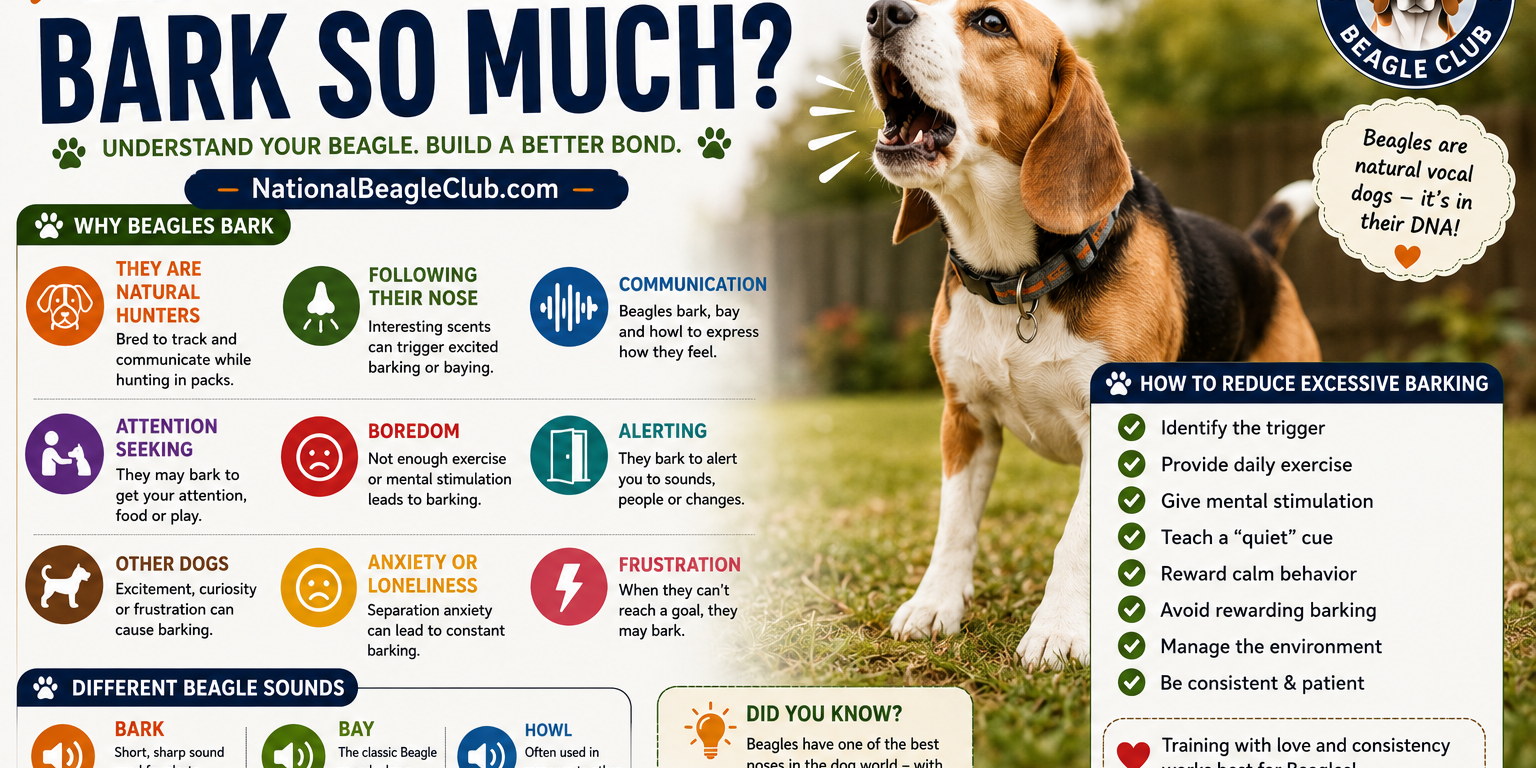
If you’ve ever wondered why Beagles bark so much, you’re not alone. Beagles are naturally vocal dogs, and barking, baying, and howling are part of their breed’s communication style.
Beagles were developed as scent hounds and were historically used to follow rabbits and hares. Their voices helped hunters follow the dogs while they were working. That instinct remains part of the breed today.
However, frequent barking doesn’t always mean something is wrong. Your Beagle may bark because they are excited, bored, seeking attention, responding to another dog, reacting to something outside, following an interesting scent, or feeling uncomfortable when left alone.
The key is to understand why your Beagle is barking before trying to change the behavior.
Why Do Beagles Bark So Much?
Quick Answer
Beagles bark and vocalize frequently because they are social scent hounds that were bred to track prey and communicate while hunting. They may bark or bay when excited, following a scent, seeking attention, responding to other dogs, feeling bored, alerting you to something, or becoming frustrated or anxious. Beagles are naturally more vocal than many breeds.
You usually cannot eliminate barking completely. Instead, focus on identifying the trigger, providing appropriate exercise and mental stimulation, teaching alternative behaviors, and rewarding calm behavior.
Are Beagles Naturally Vocal?
Yes.
Beagles are well known for their vocal abilities. The breed can produce several types of vocalization, including a conventional bark, a distinctive bay or yodel-like sound, and a howl.
Their vocal nature is closely connected to their history as hunting dogs.
When a Beagle follows an interesting scent, the instinct to vocalize can become especially strong. The American Kennel Club notes that Beagles love to use both their noses and voices and may bark or howl when they detect the scent of another dog.
This means that some Beagle barking is simply part of being a Beagle.
Why Do Beagles Bark?
There isn’t one single reason behind every bark.
Your Beagle may bark because of:
- Excitement
- Attention seeking
- Boredom
- A strange sound
- People passing the house
- Other dogs
- Interesting smells
- Frustration
- Fear or discomfort
- Being left alone
- Wanting food or play
- Territorial behavior
Dogs commonly use barking as communication, and the meaning depends on the situation and body language surrounding the bark.
Beagle Barking From Excitement
Excitement is one of the easiest barking triggers to recognize.
Your Beagle may bark when:
- You pick up the leash.
- Someone comes home.
- You prepare their food.
- They see another dog.
- You get ready for a walk.
- You begin playing.
- They discover an interesting scent.
Excited barking may be accompanied by a wagging tail, jumping, running, or other playful behavior.
Instead of yelling, teach your Beagle that calm behavior earns attention and rewards.
Beagle Barking Because of Boredom
Beagles are active, intelligent scent hounds.
A Beagle that doesn’t receive enough physical activity or mental stimulation may look for its own entertainment.
Boredom can contribute to:
- Barking
- Chewing
- Digging
- Restlessness
- Attention-seeking behavior
The National Beagle Club of America notes that Beagles are happiest when they can be active parts of their families and that excessive time alone can contribute to behavior problems such as barking and destructive behavior.
How to Reduce Boredom
Give your Beagle appropriate activities such as:
- Walks
- Scent games
- Puzzle toys
- Short training sessions
- Food-dispensing toys
- Fetch
- Supervised outdoor exploration
Mental stimulation is particularly valuable for a scent hound.
Beagle Barking at People Outside
Does your Beagle bark whenever someone walks past the window?
This may be alert or territorial barking.
Your Beagle may notice:
- Pedestrians
- Delivery workers
- Neighbors
- Cars
- Other dogs
- Wildlife
Rather than allowing your Beagle to repeatedly practice the behavior, reduce access to the trigger when possible.
For example, you can:
- Close curtains.
- Move the dog away from the window.
- Use a quiet room.
- Reward calm behavior.
- Teach your Beagle to look at you when a person passes.
Why Does My Beagle Bark at Other Dogs?
Beagles may bark at other dogs because they are excited, frustrated, curious, fearful, or trying to communicate.
Some dogs bark because they want to approach another dog but cannot. Others react because they feel uncomfortable.
Pay attention to body language.
A loose body and wagging tail may indicate excitement, while a tense posture, avoidance, tucked tail, or other signs of fear suggest a different emotional response.
Dogs can also learn barking patterns when barking repeatedly produces attention or access to something they want.
Why Does My Beagle Bark at Night?
Nighttime barking can have several causes.
Your Beagle may hear or smell something that you cannot detect.
Possible triggers include:
- Wildlife
- Other dogs
- People outside
- Unfamiliar noises
- Household activity
- Boredom
- Anxiety
Because Beagles have an excellent sense of smell, a scent outside may be much more interesting to them than it is to you.
If nighttime barking suddenly begins or becomes unusually intense, consider discussing the change with your veterinarian.
Beagle Barking When Left Alone
Some Beagles become vocal when they are separated from their owners.
Beagles are social dogs that were bred to work in groups, and they generally enjoy companionship.
If your Beagle barks continuously when alone, don’t automatically assume they are simply being stubborn.
The behavior could be related to:
- Loneliness
- Boredom
- Frustration
- Anxiety
- Lack of training
- An established habit
If you suspect separation anxiety, professional guidance from a veterinarian or qualified behavior professional can be helpful. Excessive barking associated with separation anxiety requires a different approach from ordinary attention-seeking barking.
How to Reduce Beagle Barking
The goal isn’t necessarily to make your Beagle completely silent.
Instead, teach your dog when barking is appropriate and what behavior you want instead.
1. Identify the Barking Trigger
First ask:
What happened immediately before my Beagle started barking?
Keep track of patterns.
For example:
Trigger: Person walks past window
Behavior: Beagle barks
Response: Owner approaches window
If this happens repeatedly, your Beagle may learn that barking produces attention.
Understanding the pattern makes training much easier.
2. Reward Calm Behavior
Reward your Beagle when they are quiet and relaxed.
For example:
- Your Beagle notices something outside.
- They remain calm.
- You say a calm marker such as “good.”
- Give an appropriate reward.
Over time, your Beagle can learn that calm behavior is valuable.
Positive reinforcement is recommended for Beagle training; the AKC specifically notes that Beagles respond well to patience and positive reinforcement and do not respond well to harsh training techniques.
3. Teach a Quiet Cue
Once your Beagle understands basic training, you can teach a cue such as “quiet.”
Start in a low-distraction environment.
When your Beagle stops barking naturally, calmly reward the silence.
With repetition, gradually introduce the verbal cue.
Avoid repeatedly shouting “quiet” over barking because your Beagle may interpret your louder voice as joining the excitement.
4. Provide Daily Exercise
Beagles need regular physical activity.
A suitable routine may include:
- Walks
- Play
- Scent activities
- Training
- Supervised exploration
The exact amount of exercise should be appropriate for your Beagle’s age, health, and individual needs.
Puppies, adults, and senior Beagles have different exercise requirements.
5. Give Your Beagle Mental Stimulation
Physical exercise isn’t the only answer.
Because Beagles were bred to use their noses, scent-based activities can be especially engaging.
Try:
- Hide-and-seek with treats
- Sniff walks
- Puzzle feeders
- Scent games
- Basic obedience training
- Food-search games
Mental stimulation can help reduce boredom-related behavior.
6. Avoid Rewarding Unwanted Barking
Be careful about what happens immediately after your Beagle barks.
If barking consistently results in:
- Food
- Attention
- Opening the door
- A toy
- Going outside
your Beagle may learn that barking works.
Whenever appropriate, wait for a moment of calm before providing the desired reward.
7. Manage the Environment
Training works better when your Beagle isn’t constantly exposed to overwhelming triggers.
Consider:
- Closing window blinds.
- Moving furniture away from windows.
- Using background noise.
- Creating a comfortable resting area.
- Keeping your Beagle away from highly stimulating areas when necessary.
Management isn’t a substitute for training, but it can reduce opportunities to practice unwanted barking.
What Not to Do When Your Beagle Barks
Avoid harsh responses.
Do not:
- Hit your Beagle.
- Threaten your dog.
- Deliberately frighten your dog.
- Shout continuously.
- Use punishment as your primary training strategy.
Harsh responses can increase fear or excitement and may make behavior problems harder to resolve.
The AKC recommends positive reinforcement and patience when training Beagles.
When Beagle Barking May Need Professional Help
Occasional barking is normal.
However, speak with your veterinarian or a qualified behavior professional if:
- Barking suddenly changes.
- Your Beagle becomes unusually vocal.
- Barking is accompanied by signs of fear.
- Your dog appears distressed when alone.
- Your Beagle shows aggression.
- Barking continues despite consistent training.
- You suspect pain or illness.
A sudden behavior change can sometimes have an underlying medical or emotional cause.
Understanding Different Beagle Sounds
Beagles don’t communicate only through ordinary barking.
You may hear:
Bark
Often used for alerting, excitement, attention, or communication.
Bay
A distinctive hound vocalization associated with the breed’s hunting heritage.
Howl
May occur in response to other dogs, sounds, excitement, loneliness, or environmental triggers.
The meaning depends on the situation and your dog’s body language.
Beagles are particularly famous for having multiple vocalizations.
Frequently Asked Questions About Beagle Barking
Why Do Beagles Bark So Much?
Beagles are naturally vocal scent hounds. Their barking and baying are connected to their history as hunting dogs, but individual barking can also be triggered by excitement, boredom, attention seeking, other dogs, environmental sounds, frustration, or anxiety.
Are Beagles One of the More Vocal Dog Breeds?
Yes. Beagles are well known for being vocal and can use barking, baying, and howling to communicate. Their hunting background helps explain why vocalization is such a noticeable part of the breed.
Can You Train a Beagle to Bark Less?
Yes. You can teach your Beagle alternative behaviors and reward calmness. Identifying triggers, providing appropriate exercise and mental stimulation, and using positive reinforcement can help reduce nuisance barking.
Why Does My Beagle Bark at Everything?
Your Beagle may be reacting to sounds, movement, smells, other dogs, people, excitement, boredom, or attention-seeking opportunities. Identify the specific trigger before deciding how to address it.
Why Does My Beagle Bark When I Leave?
Your Beagle may be bored, lonely, frustrated, or experiencing separation-related distress. If the barking is persistent or accompanied by signs of anxiety, speak with a veterinarian or qualified behavior professional.
Should I Ignore My Beagle When It Barks?
Not always. Ignoring attention-seeking barking can sometimes be appropriate, but first determine why your Beagle is barking. A dog barking because of fear, distress, illness, or another important need should not simply be ignored.
Do Beagles Ever Stop Barking?
Beagles generally remain vocal throughout their lives. The goal is not necessarily to eliminate barking but to teach your dog appropriate ways to respond to common triggers.
Final Thoughts
So, why do Beagles bark so much?
The simple answer is that vocalization is part of what makes a Beagle a Beagle.
These friendly scent hounds were bred to track and communicate while hunting, so barking, baying, and howling are deeply connected to their natural behavior.
You may not be able to make your Beagle completely quiet—and you shouldn’t expect them to behave like a naturally quiet breed.
Instead, focus on understanding the reason behind the barking.
Provide enough physical activity, give your Beagle opportunities to use their incredible nose, teach calm alternative behaviors, reward quiet moments, and manage common triggers.
With patience and consistent positive training, you can reduce nuisance barking while still allowing your Beagle to express the natural behaviors that make the breed so special.